Five hundred suppliers into the ERP, researched by an agent
Every unknown brand a customer asked for meant a manager reading supplier lists off websites and retyping them. An agent now does the research and the manager only approves.
- Client
- Spare parts & industrial equipment · Germany · $15M revenue · 100 staff
- Scope
- Brand research → supplier discovery → ERP
- Control
- Manager approves before anything is written
- Role
- Solo — design, build, hand-over
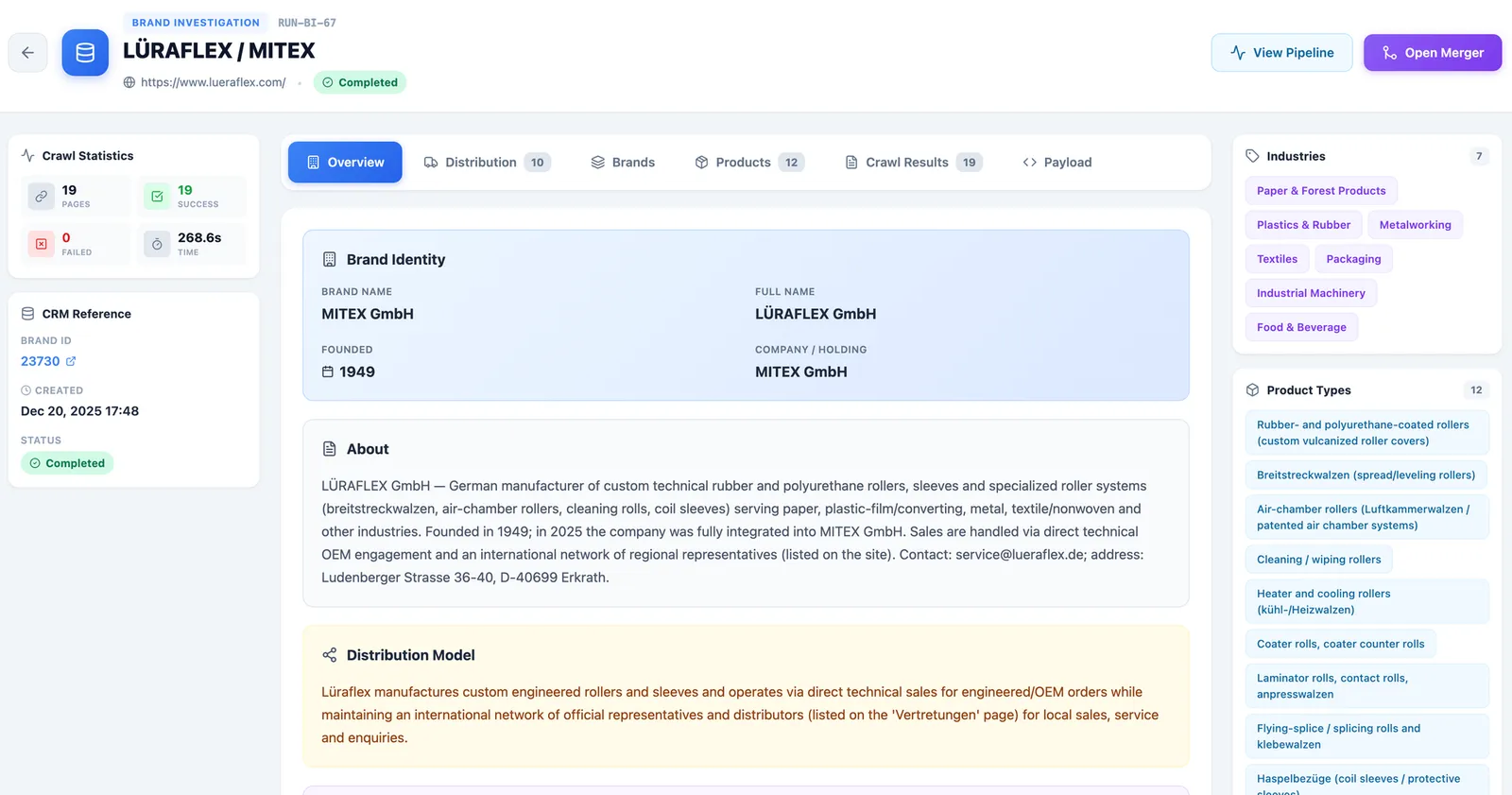
Every new brand meant a manual research project
When a customer asked for a brand the ERP had never seen, someone had to go and find it — and its suppliers.
Brands usually publish their authorised suppliers somewhere on their own website. A manager would work through those pages, gather information about the brand, note down the suppliers, and transfer all of it into the ERP by hand.
On top of that, a monitoring pass had to be run every few months to catch newly listed suppliers. Both jobs were pure reading and retyping, and both landed on the same small team.
An agent that researches, then asks permission
Parsing and extraction are automatic; nothing reaches the ERP until a manager has looked at it.
Enter the brand
inputThe manager opens the dashboard and types the brand name — that is the whole manual input.
Parse the web
researchThe agent crawls and parses the brand's site and related sources, then runs the content through an LLM.
Extract and propose
extractBrand details, supplier lists and product information are extracted and submitted for confirmation.
Human approval
checkpointThe manager reviews what was found and approves or corrects it — master data is never written on the agent's word alone.
Sync to the ERP
erpApproved changes are synced into the ERP as proper brand and supplier records.
500+ suppliers and 230 brands, at a fraction of the effort
Counted from the records the agent produced and a manager approved.
New suppliers added to the ERP
Industrial brands onboarded
Of research and data entry saved
 Python
 PostgreSQL