Thousands of RFQ emails a month, handled without a reading team
A German spare-parts distributor kept five people busy just opening inbound mail. Now every request is qualified, structured and pushed into the ERP before a purchase manager sees it.
- Client
- Spare parts & industrial equipment · Germany · $15M revenue · 100 staff
- Scope
- Intake → qualification → matching → ERP
- Volume
- 300–500 emails a day
- Role
- Solo — design, build, hand-over

Five people whose whole job was opening the mailbox
Thousands of RFQ emails a month arrived in one shared inbox — genuine requests mixed in with spam and virus attachments.
The flow was processed entirely by hand. Someone had to open every message, decide whether it was a real request, spam or an infected attachment, then pull out part numbers, quantities and descriptions and look up whether the customer and the brand already existed in the ERP.
At 300–500 emails a day, that meant keeping a team of five on the inbox permanently — and the work scaled linearly with volume.
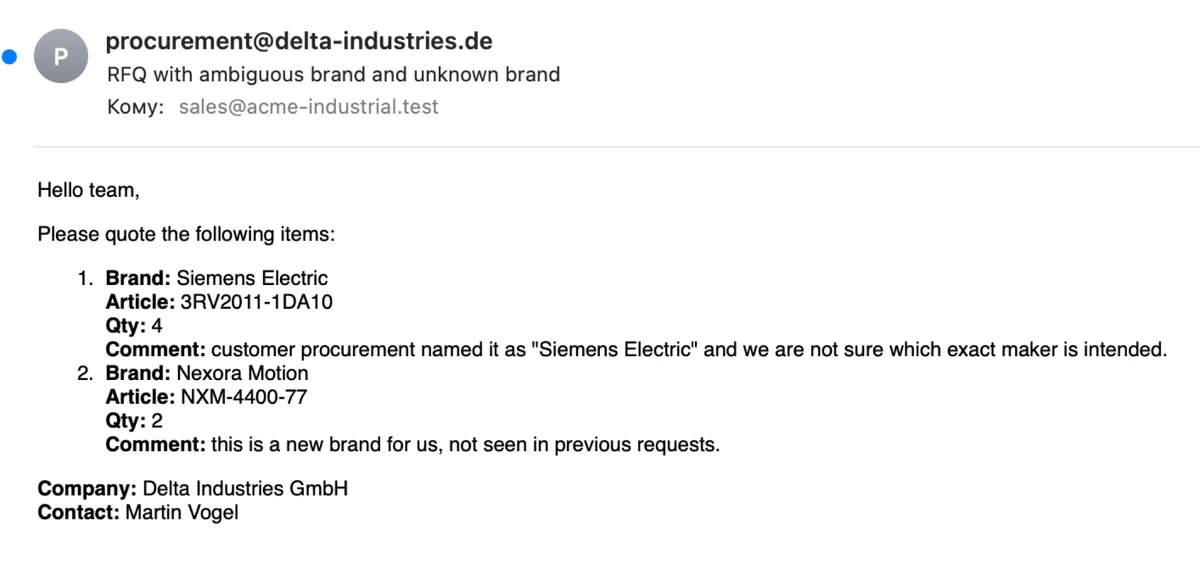
A platform that reads the inbox and fills the ERP
A web interface plus a backend pipeline that takes an inbound lead and returns structured, ERP-ready data.
Lead qualification
triageEach message is classified as a genuine RFQ, spam or a malicious attachment — the filter that removes most of the manual reading.
Customer matching
matchThe sender is matched against the customer database, or a new customer record is created when there is no match.
Brand matching
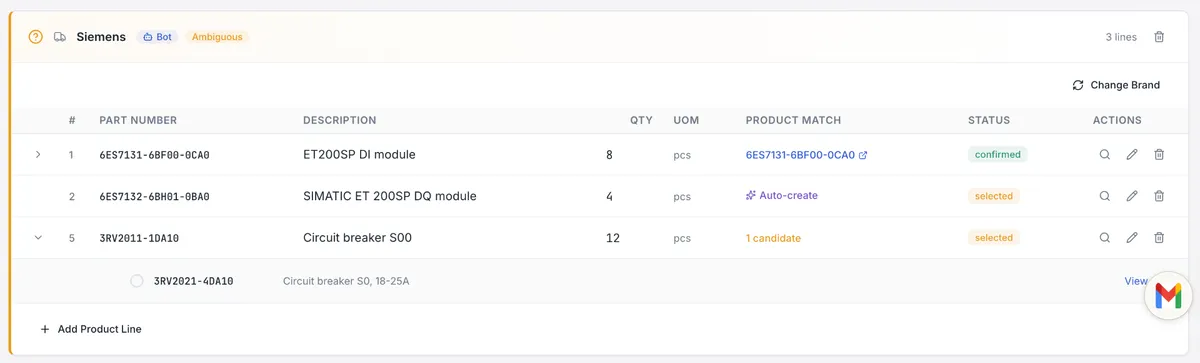
matchBrands named in the request are resolved against the brand database, with a new record created when the brand is genuinely new.
Line-item extraction
parsePart numbers, quantities and descriptions are pulled out of free-form text and turned into structured lines.
Sync to the ERP
erpThe processed request is written to the ERP and handed to the purchase manager, who starts from structured data rather than an email.

About eighty hours a week back, and a clean inbox
Measured against the manual intake process it replaced.
Saved per week across the team
Accuracy detecting spam and viruses
Emails a day handled without a reader
 Python
 PostgreSQL